How to Understand Seasonal Movement of Your Fence Door


- Gates
- Railings
- Fencing
- Accessories
& Fitting- Sheds
& Storage- Garden Structures
- Design
& Style2026-04-20
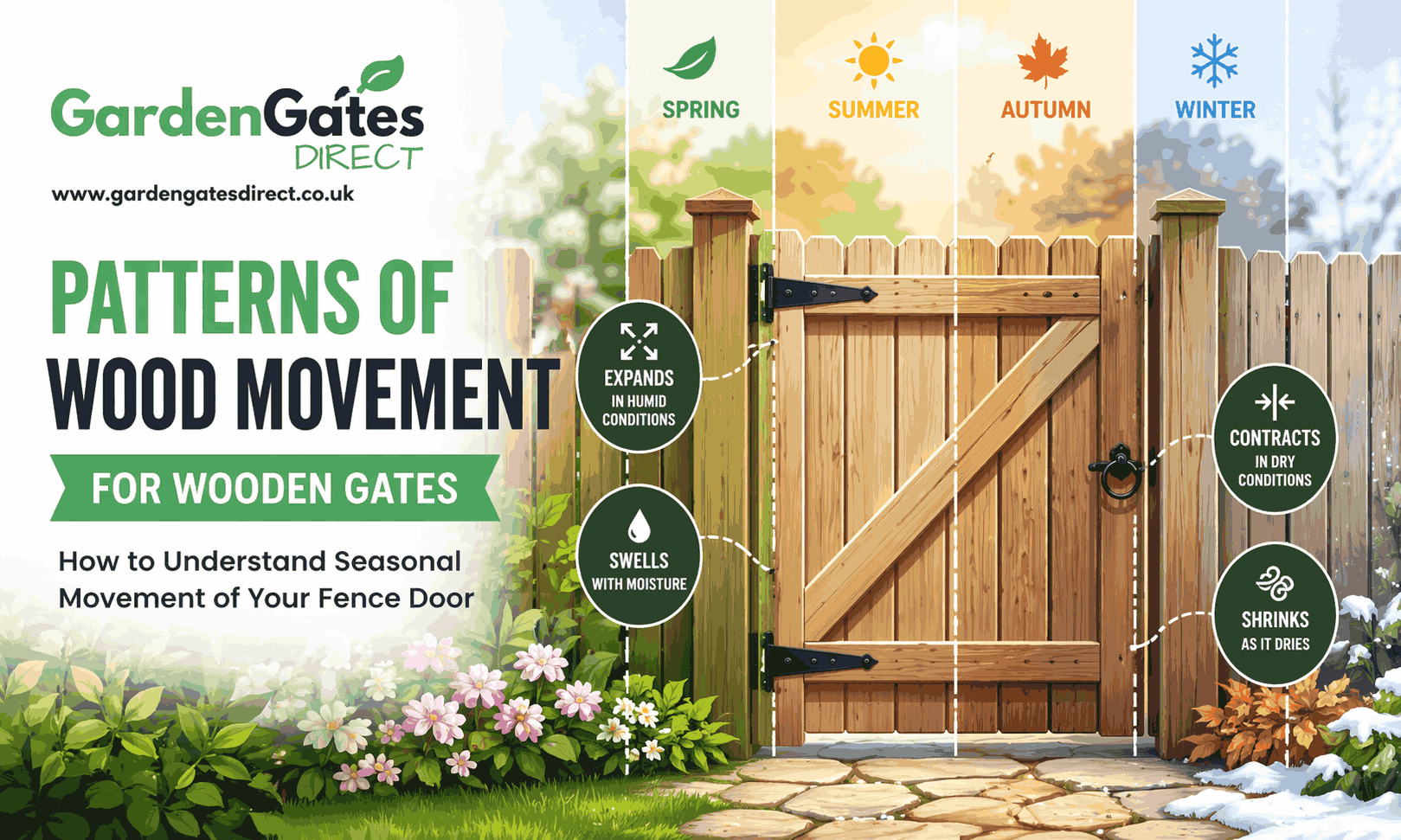
Wooden gates move. Not sometimes, but all the time, even if installed correctly. Distinguishing normal wood movement patterns from a problem is crucial, and this is exactly where knowledge comes into play.
April allows you to see the wood movement in action perfectly well. Gates which used to work perfectly throughout the previous months may suddenly start to bind. Latches which used to catch nicely on strike plates become less accurate. All the gaps around the perimeter of the gate become larger. None of these issues can be a sign of a problem per se – wooden gates simply move in response to seasonal atmospheric moisture content.
Over the past 25 years, our team at Garden Gates Direct discussed these wood movements and helped thousands of clients to distinguish what was wrong in their cases and what was just normal. When people understand what is happening to their wooden fence door and why, they feel more comfortable and ready to react adequately to future changes.
Seasonal Changes in Moisture Content and Its Effect on Gates
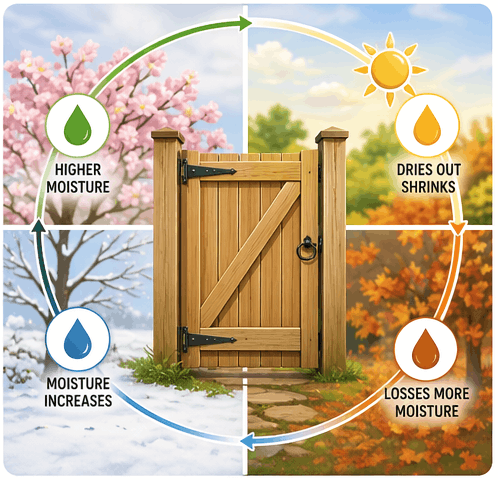
Wooden gates are spongy materials. However, unlike regular sponges, they soak up moisture really slowly. In the spring, humidity starts increasing steadily, causing the gates to expand in size. Wood swelling happens unevenly: while wood expands 2 times faster across the grain direction, no expansion is noticed along it.
April is the period of maximum wood expansion because winter is gone, bringing a lot of moisture. This causes timber to swell really quickly and, therefore, the movements can be seen clearly.
However, not all wood reacts to seasonal changes equally. There are several variables which affect expansion speed and amplitude:
Species. Oak acts differently from pine and others. Moisture content at installation. If there was too much moisture, wood will move more. Effectiveness of protective treatment of the fence door. Depending on the coating, wood either moves less or becomes more prone to seasonal changes. Construction method.
How Your Wooden Gate Should Move in April and Why It Is Important
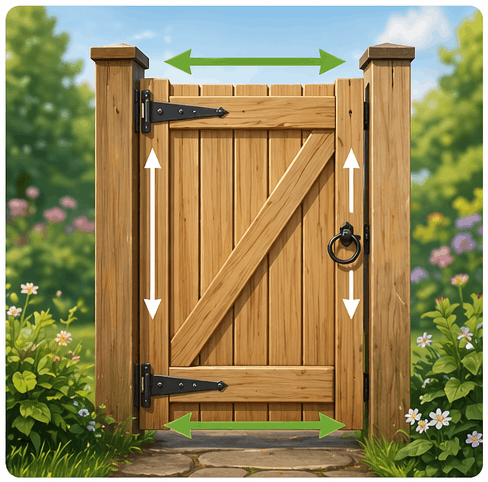
Understanding these normal wood movement patterns helps you to see the difference between what is expected and what requires immediate action.
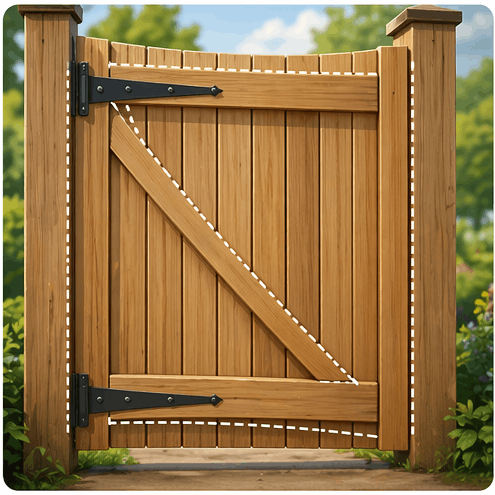
If you notice that your gate became an approximate parallelogram, instead of remaining a perfect rectangle, chances are high that this is a normal reaction of wood to changing atmospheric moisture content. Check how diagonal dimensions differ: difference of 10-15mm is acceptable, anything above 25mm indicates a problem.
Your gate does not look correct in terms of alignment, but the reason lies in wood moving, not in posts becoming not vertical anymore. Over time, as moisture levels change, the racking will return and the gate will become squared again.
Changes in Gap Patterns
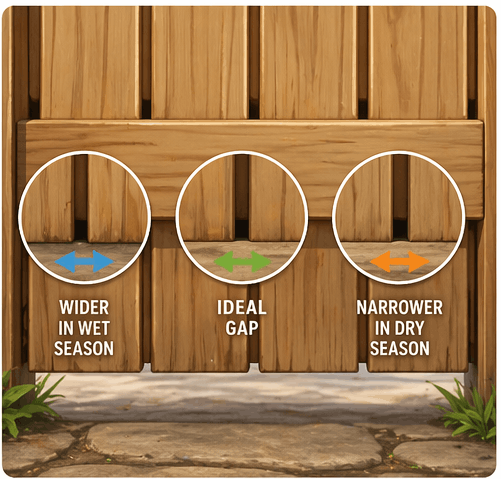
Changes in gap sizes between your fence gate and posts can tell a lot about how wood has moved over the course of last few months. However, some of the changes indicate correct behaviour and some of them require intervention.
Uniform gaps mean that the gate is still squared, however, has moved slightly in total dimension. This is a good sign. Uneven gaps point to differential movements and may require further investigation. For example, wider gaps on top and narrower ones below the gate usually mean that your gate expands more on its top side. This occurs because upper parts tend to get more sunlight.
If gaps become larger without changing your gate shape, it means that your gate simply expanded. For instance, expanding of 5mm will create a 5mm gap on latch side.
Surface Planes Distortions
Sometimes, gates remain square, but their surfaces do not stay flat anymore. You need to take a careful look at the boards and check whether any distortions appeared. A bow within 5-10mm across your fence door's width is absolutely fine, but if a twist develops with more than 15mm distance between corners and a straight line across the fence, your gate has some problems.
When You Need to Intervene
Although wood movement is normal, sometimes this process shows some abnormalities pointing out the real trouble and requiring immediate actions.
Persistent and Progression
In case if a fence gate keeps expanding or contracting all the time and never returns to normal position, it needs a closer look. Take regular measurements and try to take pictures to compare how the gate looked in April of this year and in April next year and even later. Progressive worsening is a clear sign of actual warping.
Localised Severe Distortions
It may happen that not the entire gate moves but just individual boards. Such situation usually arises due to coating failure allowing moisture to penetrate one surface of a board more than another, thus causing it to twist.
Inspect these boards for coating defects, knots or grain pattern that predisposes wood to movement. You may need to replace them to avoid further problems.
Splitting
Small surface cracks are normal for any timber, yet splitting that penetrates through a board needs to be addressed immediately. It happens when moisture pressure exceeds a strength of the wood fibre and it cracks.
Sudden splits often stabilise with a change of weather conditions, while progressive splits should definitely be fixed.
Why April Is Great for Assessing Your Wooden Fence Door

All these changes occur in April to the largest extent. They reveal the worst possible scenario. Gates which are able to operate in April conditions will easily cope with summer conditions.
Take exact measurements and pictures of your fence door and note all the changes in gaps and locations of latches. Comparing future situations with what you observed this April is really helpful in seeing any progression of abnormal behaviour. At Garden Gates Direct, we understand that educated clients will make better maintenance decisions for their fence doors. And if you’re in need of a brand new wooden gate or fence, be sure to check out our range.
- Railings